Tuesday, January 22, 2019

Employee Motivation Lessons from the Military


Unlike Hollywood’s depiction of motivation in the military (the harsh drill sergeant) the armed services have developed much more sophisticated ways to motivate improved performance.  Not many would argue that collectively the US Military is the best in the world.  It's also no wonder that those who have served often go on to successful careers as leaders in many industries.

What lessons can we learn from how the military communicates and trains its leaders and troops? 

The military has known for years that their  personnel are motivated by recognition.  In the 1700’s it was Napoleon who coined the phrase:

“A soldier will fight long and hard
                                                for a bit of colored ribbon.”
                                                                     
After researching several articles on the subject, here are just a few of the ideas on motivation and leadership that we found:
  • Your focus should always be on leadership and team building
  • Your concern and interest in your employees has to be real.  If you can’t muster true empathy and pride in the people who work for you, you won’t go as far as you think you should
  • Always put your employees needs first
  • Empower your employees to perform at their highest levels, take roadblocks and needless regulations out of the way.
  • Make sure that what you ask your employees is attainable and then tell them the how and the why 
  • Effectively communicate your vision and objectives through as many different objectives as you can.
  • Manage by walking around and showing genuine interest in your people
  • Make recognition and appreciation a constant
  • Respect those who report to you as individuals and you cannot take them for granted

For more information on Ultimate Choice Inc.’s products or services or other white papers please contact us at Ultimatechoiceinfo@cox.net


Tuesday, January 8, 2019

Employee Engagement Drives Significant Corporate Benefit


The Gallup’s most recent State of the American Workplace report paints a fairly clear picture or how important employee engagement is to company success. 
When compared to organizations with lower levels of employee engagement, those with higher levels of engagement typically experience these type results:
  • 41% lower absenteeism
  • 24% lower turnover (high turnover industries)
  • 59% lower turnover (low turnover industries)
  • 28% less shrinkage
  • 70% fewer employee safety incidents
  • 58% fewer patient safety incidents
  • 40% fewer quality incidents (defects)
  • 17% higher productivity
  • 20% higher sales
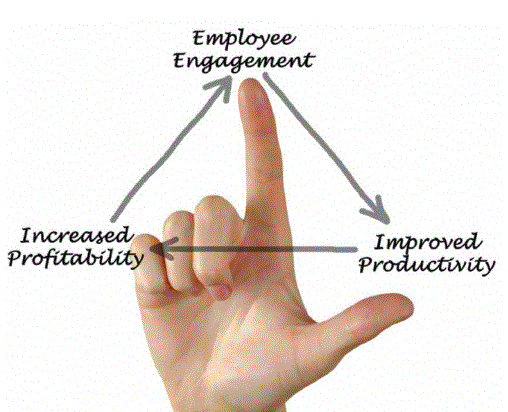
  • 21% higher profitability
As the majority of employee engagement is based on employee satisfaction, and employee appreciation and recognition is a key component of satisfied employees, it is also fair to say that employee recognition and awards are key in increasing performance.  For years, the C-Suite constantly asked for the return on investment of recognition and reward dollars.  Is it not also fair to say that employee rewards systems can drive bottom line results and the increase in profits noted by the stats above?

For more information on Ultimate Choice Inc.’s products or services or other white papers please contact us at Ultimatechoiceinfo@cox.net

Tuesday, December 18, 2018

The Linchpin Between Employee Engagement and Customer Satisfaction


For years many of us have understood that employee recognition and awards have had a great deal to do with employee engagement and results.  Since the 1950’s the award industry has been connecting the dots and motivating the relationship between the customer and corporate employees. They were engaging employees to provide the best customer service they could….and it worked for many clients

Yet, employee engagement is now a field that is inundated with consultants and solution providers whose approach to improving engagement runs the gamut of satisfaction research, communications, real time measurement, new technology, training, leadership coaching, assessment, etc.  The one thing that is almost always left out of the equation by these suppliers is the rewards and recognition system combined with the analytical tools to deploy it in an audit-able manner.

We pondered the “why have rewards been left out of this equation” question for a long time.  And in our opinion, the main reason that these award companies missed the boat on this was because they put all their eggs in the “making their money by selling the awards” basket.  It was a simple matter of math.  If the client had $3 million to spend on the engagement problem, about 80% of it was spent on the awards after the fact, and the other 20% on the communications, research, feedback and training.  Even though these companies had highly skilled professionals in these ancillary areas, they often priced them at cost (or even lower) to be in a better position to compete for the award business. These traditional firms are known in the trade as “incentive companies.” 

If the linchpin between employee engagement and customer satisfaction is reward and recognition, the industry still has a long way to go to inform corporate America of it.  Recent incentive industry research shows that over 70% of companies use the award industry just for the awards.  They purchase the other needs of communications, feedback, training etc. from other providers, or do it themselves.

If you need expertise on how to drive employee engagement to achieve corporate results, you might try an incentive company.  They have been basing their success on the successful achievements of these programs for years.   

For more information on Ultimate Choice Inc.’s products or services or other white papers please contact us at Ultimatechoiceinfo@cox.net


Tuesday, December 4, 2018

The Employee-Engagement Story


There has been so much written about Employee Engagement that it has frankly become a confusing catchall for almost everything related to employee performance.  It means different things to different people and certainly all types of vendors and consultants have found a home in this umbrella in order to sell their services.
As employee engagement is essentially a behavior change initiative, the incentive industry was implementing employee engagement activities long before the phrase was ever coined. Multi-million dollar “incentive companies” emerged in the mid-20th century to sell programs to motivate company employees (either internal or external) to improve their performance in a variety of ways.  These programs were very successful and did drive performance because they used motivation techniques invented by the award industry….techniques that are still very prominent today. 
Following is a synopsis of an article written by Paul Herr, Author of “Primal Management: Unraveling the Secrets of Human Motivation that Drive High Performance”, that is as good a treatment of the connection between employee motivation and employee engagement as we have ever read.
ZERO MOTIVATION, no work would get done and the company would go bankrupt. 
OPTIMAL MOTIVATION, everyone works faster, better and smarter, so productivity, innovation, customer satisfaction and profits would sky rocket.  
THE MASTER METRIC, Motivation drives everything happening inside companies and it should be tracked religiously.
THE STORY
The term “employee engagement” was popularized by the Gallup Organization about 30 years ago.  It gained the attention of the business community by aiming its statistical prowess at human motivation.   Prior to that there were no stats to determine if satisfied employees were more productive than unsatisfied employees.
By reviewing all the top theories of psychologists dealing with human motivation, Gallup  then created hundreds of questions based on these theories and started testing them to see which ones statistically correlated with business performance.  
The result of this gargantuan effort was the Gallup Q-12 survey—12 questions which has been extremely important in measuring motivation.  And employee engagement has become a top business priority for senior executives.  To read the entire article click here.
For more information on Ultimate Choice Inc.’s products or services or other white papers please contact us at Ultimatechoiceinfo@cox.net