Tuesday, April 16, 2019

Motivating Diverse Employee Groups


Incentive Magazine recently asked experts from various award companies for their tips on motivating diverse groups of participants.  These companies plan incentive programs for employees with a wide range of backgrounds, interests, roles and, of course, award preferences. While there are obvious differences in employee backgrounds, communication strategies and award delivery preferences, motivating this diversity is more common across these lines than you might think.

The following list of tips that offers good insight into the things you need to keep in mind when planning your award programs.  Some are more along the common sense side, but others may give you some good food for thought. 

Understand Your Audience
Survey your employees to find out what is meaningful to them. You will already know much of what they say, but could also come up with some good ideas to put in the program.

You can take surveys to the extremes with audience persona development, segmentation and generational components, etc., but that type of employee research would not really be necessary for most programs.

Effectively Launch the Program
Most companies don’t put as much emphasis on this phase of the reward program as they should. They assume that just the mention of the programs and “what’s in it for me is sufficient to gain excitement at the beginning.  But better launch preparation will provide dividends and actually allow you to spend less on the ongoing communications phase throughout. The importance that your participants put on your program will be in direct proportion the effort and importance you give the launch.

Clear and Consistent Communications
Communications doesn’t have to be expensive to be effective.  But you do need to take it out of your normal communications efforts and do it as often as appropriate for your organization. Communications about what employees can earn in rewards will be read and retained. If unsure how much and how often to communicate, err on the side of more and more frequently. In addition make sure your messaging is custom and speaks directly to the individual such as program standings, percentage towards qualification, and status updates etc.

Don’t Just Use Digital Communications
It’s natural to use digital as your first option, but old-fashioned printed pieces, posters etc are still very effective and enjoyed by most.  They are also often retained and shared with the family.

Have a User-Friendly IT Platform
The award industry is loaded with the “best mouse traps” incentive software.  Our advice has always been “Don’t go hunting squirrels with a bear rifle.”  We estimate that UP TO 90% of the features in current software are either not or underutilized. It also needs to be easy to use.

Recognize and Reward Teams
The incentive industry has known for years that you can get tremendous success by incorporating team awards in your program. Take advantage of it wherever possible, but use it in combination with individual awards.

If Using Travel, Tailor it to Your Employees 
If you using travel as the prominent award make sure you plan it with the participant in mind. Sun and fun can be highly motivation to the younger set, but not so much for older generations who may enjoy sightseeing and new experiences. And, don’t let your C-suite determine your destination based on where the executive wants to go. 

Don't Forget Gift Cards
When it comes to an award that appeals to everyone, gift cards offer the largest choice of any award in the industry. They have become by far the leading option for non-travel awards.

Make Sure It's Measurable 
This tip should actually be number one and not the last.  Without measurement you won’t have much motivation. Not having measurement is like bowling with a curtain in front the pins.  Make sure your objectives are measurable and communicate individual and team performance at the beginning, often in the middle and the end.

For more information on Ultimate Choice Inc.’s products or services or other white papers please contact us at Ultimatechoiceinfo@cox.net

Tuesday, April 2, 2019

Great Ways to Improve Your Employee Recognition


We are often asked by clients for different ways to improve employee recognition, or to kick it up a notch.

While many of the following ideas may seem obvious to some, you might be surprised how rarely we find them in use. 

Write Out in a Formal Letter
Write the letter on company letterhead; tell the employee what they did, how their actions impacted the company and other employees. Send it to the employee, give a copy to the department head and CEO, place a copy in the file.  If suitable, publish it in a company form of communication. 

Write a Personal Note
Write it out long hand on some nice personal note paper, (print legibly if handwriting not suitable) do not send an email. You might also want to have a manager co-sign it. Photocopy the note and place the recognition in the employee’s file.

Accompany the verbal recognition with Recognition Item
Engraved plaques, merchandise that carries the company logo, even certificates of appreciation reinforce recognition.

Everyone Likes Gift Cards
Accompany the letter or note with a token or diminimous gift card.  They are enjoyed by everyone, and can be shared with the family.

Present the Recognition Publicly.
Even if the employee is uncomfortable with publicity, it is important for the other employees to know that employees are receiving recognition.

Encourage Peer to Peer Recognition
Set up a simple system to allow and encourage employees to recognize employees in their department and in cross functional departments. Consider implementing a budget allowing each employee an amount they can give annually.  Using gift cards is the easiest way to make this work.

A Simple “Thank You” Counts
A simple “thank you” counts as employee recognition. It’s quick, easy to do, and can go a long way, and helps to create a positive environment.  You cannot use recognition up. You cannot run out of recognition.

No budget is too small to afford employee recognition. If you want increased employee satisfaction and engagement, bring on lots of employee recognition. You'll be happy that you did.

For more information on Ultimate Choice Inc.’s products or services or other white papers please contact us at Ultimatechoiceinfo@cox.net

Tuesday, March 19, 2019

Real Time Data Can Drive Employee Engagement


Engagement in some organizations just seems to happen naturally.  In others it seems uneven and difficult to sustain. People seem to be treading water, there’s no real enthusiasm, momentum or positive attitude.  But this disengagement is not always visible.  A paper written by Glint entitled “The Chemistry of Engagement” reveals the data-driven strategies of innovative companies who have adopted emerging technology of real-time employee engagement.

There are many organizations that don’t realize they have an engagement problem until they have a retention or performance problem. They gain understanding from these issues, but often it is too little too late.

Consider these stats from recent research:


  • 77% of CEOs feel they don’t have the right systems to address the issue of employee engagement (Deloitte)
  • 79% of CEOs believed they have a significant retention and engagement problem (Deloitte)
  • 18% of employees are actively engaged, only 30% of employees are engaged, 52% are disengaged (Forrester Research)


Here are three reasons often given by HR leaders for these above findings:


  • There are challenges staying connected as the company grew and became more successful.With rapid growth there are so many new people that old employee surveys weren’t working
  • The diversity and disbursement of employees makes it difficult to maintain cohesiveness and engagement.
  • The wide variety of employee types (salaried, hourly, technical, customer facing, main office, remote etc.) makes it difficult to keep them all engaged
  • With constant management changes because of growth there is a lack of consistency.


One answer to all the above according to Glint is real-time measurement using real-time technologies.  If the problem is present, you need present time data to solve it. 

But three factors have kept companies from measuring in real-time:

1. The annual survey because it is still just annual

2.  It’s not just an HR thing.  While HR has been the owner of measuring engagement and the strategies to use to improve it, it’s very difficult to drive behaviors across large and diverse organizations.

3. An issue of money or time. Many companies are forced to limit consultant based research to once a year, and if they do it themselves, the time and manpower to do it right can be very lengthy thus mitigating the “real-time” issue.

The answer, according to Glint, is to use the platform they have developed that creates programs for measuring and improving engagement, understands which factors drive employee satisfaction and empowers managers with interactive dashboards to lead them to action.  

While this certainly sounds like a workable approach to improving engagement, it leaves out a very important piece of the puzzle.  To change behavior you need to include positive reinforcement to turn those changes into habits.  Employee recognition and rewards has always been a driver of employee engagement.

For more information on Ultimate Choice Inc.’s products or services or other white papers please contact us at Ultimatechoiceinfo@cox.net

Tuesday, March 5, 2019

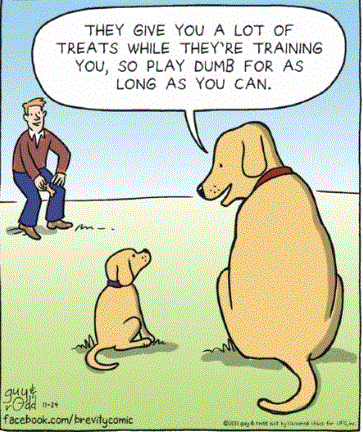
Reinforce Performance to Shape Behavior


From the Aubrey Daniels Institute comes the following information on “Shaping” that we found particularly interesting when considering behavior change within employee recognition.  The information comes from previous commentary by Dr. Andy Lattal, the Centennial Professor of Psychology at West Virginia University

While we don’t often hear the terminology, shaping is when a person who has a target response he wants, proceeds to reinforce the “shapee” with approximations of that response in order to change behavior. In this context, “shaping” is one of the most ubiquitous of all behavioral phenomena. An example from Lattal:

“Consider, for example a child who has a skill deficit in, say, making a certain sound. The shaper knows what the sound should sound like, and provides reinforcement for close and closer approximations to the sound until the child eventually produces the sound as it should sound. This is an accurate description of what happens, but it omits an important element in many instances of shaping that involve people in everyday situations: the behavior of the shaper is not immune to the consequences of his or her attempts to shape the behavior of the shapee.”

Shaping relies on positive reinforcement as the results get closer and closer to the target.  When you use a “positive reinforcer” that a person desires, the behaviors will more likely result in a positive outcome.


While we are rarely cognizant of this phenomena, the behavior of the managers in providing recognition is essential to the employee to improve performance.  In addition, the manager is also positively affected by the positive performance of the employee.  They are more likely to provide the recognition when the employee is engaged in the target response. As a result, there is a reciprocal relation for reinforcement for both, a sort of “you scratch my back and I’ll scratch yours” arrangement.

For more information on Ultimate Choice Inc.’s products or services or other white papers please contact us at Ultimatechoiceinfo@cox.net