Tuesday, March 19, 2019

Real Time Data Can Drive Employee Engagement


Engagement in some organizations just seems to happen naturally.  In others it seems uneven and difficult to sustain. People seem to be treading water, there’s no real enthusiasm, momentum or positive attitude.  But this disengagement is not always visible.  A paper written by Glint entitled “The Chemistry of Engagement” reveals the data-driven strategies of innovative companies who have adopted emerging technology of real-time employee engagement.

There are many organizations that don’t realize they have an engagement problem until they have a retention or performance problem. They gain understanding from these issues, but often it is too little too late.

Consider these stats from recent research:


  • 77% of CEOs feel they don’t have the right systems to address the issue of employee engagement (Deloitte)
  • 79% of CEOs believed they have a significant retention and engagement problem (Deloitte)
  • 18% of employees are actively engaged, only 30% of employees are engaged, 52% are disengaged (Forrester Research)


Here are three reasons often given by HR leaders for these above findings:


  • There are challenges staying connected as the company grew and became more successful.With rapid growth there are so many new people that old employee surveys weren’t working
  • The diversity and disbursement of employees makes it difficult to maintain cohesiveness and engagement.
  • The wide variety of employee types (salaried, hourly, technical, customer facing, main office, remote etc.) makes it difficult to keep them all engaged
  • With constant management changes because of growth there is a lack of consistency.


One answer to all the above according to Glint is real-time measurement using real-time technologies.  If the problem is present, you need present time data to solve it. 

But three factors have kept companies from measuring in real-time:

1. The annual survey because it is still just annual

2.  It’s not just an HR thing.  While HR has been the owner of measuring engagement and the strategies to use to improve it, it’s very difficult to drive behaviors across large and diverse organizations.

3. An issue of money or time. Many companies are forced to limit consultant based research to once a year, and if they do it themselves, the time and manpower to do it right can be very lengthy thus mitigating the “real-time” issue.

The answer, according to Glint, is to use the platform they have developed that creates programs for measuring and improving engagement, understands which factors drive employee satisfaction and empowers managers with interactive dashboards to lead them to action.  

While this certainly sounds like a workable approach to improving engagement, it leaves out a very important piece of the puzzle.  To change behavior you need to include positive reinforcement to turn those changes into habits.  Employee recognition and rewards has always been a driver of employee engagement.

For more information on Ultimate Choice Inc.’s products or services or other white papers please contact us at Ultimatechoiceinfo@cox.net

Tuesday, March 5, 2019

Reinforce Performance to Shape Behavior


From the Aubrey Daniels Institute comes the following information on “Shaping” that we found particularly interesting when considering behavior change within employee recognition.  The information comes from previous commentary by Dr. Andy Lattal, the Centennial Professor of Psychology at West Virginia University

While we don’t often hear the terminology, shaping is when a person who has a target response he wants, proceeds to reinforce the “shapee” with approximations of that response in order to change behavior. In this context, “shaping” is one of the most ubiquitous of all behavioral phenomena. An example from Lattal:

“Consider, for example a child who has a skill deficit in, say, making a certain sound. The shaper knows what the sound should sound like, and provides reinforcement for close and closer approximations to the sound until the child eventually produces the sound as it should sound. This is an accurate description of what happens, but it omits an important element in many instances of shaping that involve people in everyday situations: the behavior of the shaper is not immune to the consequences of his or her attempts to shape the behavior of the shapee.”

Shaping relies on positive reinforcement as the results get closer and closer to the target.  When you use a “positive reinforcer” that a person desires, the behaviors will more likely result in a positive outcome.


While we are rarely cognizant of this phenomena, the behavior of the managers in providing recognition is essential to the employee to improve performance.  In addition, the manager is also positively affected by the positive performance of the employee.  They are more likely to provide the recognition when the employee is engaged in the target response. As a result, there is a reciprocal relation for reinforcement for both, a sort of “you scratch my back and I’ll scratch yours” arrangement.

For more information on Ultimate Choice Inc.’s products or services or other white papers please contact us at Ultimatechoiceinfo@cox.net
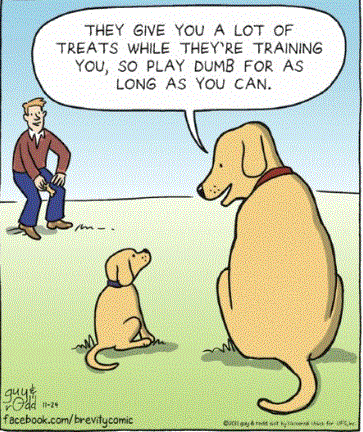
Tuesday, February 19, 2019

How Much to Budget for successful Employee Recognition?


We certainly don’t mean to be flippant, but the only plausible answer to this question is “Whatever it takes”! What we are certain about is that the vast majority of employee recognition programs are underfunded. Then again we sell these for a living so that’s what we should say….right?  Not really.  These are programs are underfunded because the vast majority of recognition programs are not measured with regard to any meaningful objective result that finance folks can touch and feel. 

There is a good deal of research showing that the companies with highest the employee engagement have the best bottom line results and that employee recognition is essential to improving employee engagement. While the studies are sound, in our experience, the C-suite hasn’t really bought into them.  It would be hard to find an executive who says he/she doesn’t agree with recognizing employees. But when asked how much to spend, there draw a blank. 

Recognition budgets are usually put together top down and the recognition program planners then try to implement a program that makes sure they don’t spend any more money than that.  Improving employee satisfaction, improving the culture, improving communications, improving anything takes a back seat to not spending any more than the given budget. 

Traditional employee incentive programs that did target a true bottom line result were budgeted differently.  Companies used a specific % of income during the program period as a method to determine how much to spend.  The % was 1-3% of income of the participants in the program for a long term (annual) program and 5% to 15% for shorter ones.  Or, they set aside a % of the sales or profits generated by the program as the budget. 

If you want to determine how much your senior management believes in the importance of employee recognition just do some simple math.  Take 100% of any monies you spend on any non-cash awards you use to recognize employees and divide that number by the number of your employees.  Then honestly ask yourself if you think that number would truly motivate you to improved performance?

So when you are considering a budget for employee recognition, the closer you can get to objective achievement numbers that can be measured, the closer you will get to a budget that will prove motivational.  Otherwise you will be left with taking the number you are given and trying to do the best with it. This is the recipe that produced the ubiquitous Person of the Month programs that were negligible in improving performance of your core employees.

For more information on Ultimate Choice Inc.’s products or services or other white papers please contact us at Ultimatechoiceinfo@cox.net

Tuesday, February 5, 2019

Five Ways Social Media Has Helped Employee Recognition


Some would say that social media has become the greatest channel of communications ever invented.  It’s only been in existence since the mid 90’s and it’s mindboggling how it has taken over our lives from a social and a business standpoint.  To say it is ubiquitous is an understatement.  Whatever it may be, it has had an enormous impact on the recognition and reward business.

Here are some very important ways social media has transformed recognition since it showed up:

Program Consolidation
In the old days large scale award systems were run on main frame computers and were complex and unwieldly.  Remember the six foot stacks of computer printouts on your desk?  The time and cost to implement one was exorbitant.  Today using excellent software designed by many reward companies, these programs are run over laptops and on phones.  The programs are more consolidated and can handle multiple initiatives and manage all the usage data.

Instant Feedback
One of the most important elements of any reward or incentive program is feedback, the sooner the feedback the better.  Millennials don’t remember when we had to wait 30-45 days for the monthly reports to see how we were doing in our incentive program.  We live in a culture of instant feedback, and it was brought to us by social media.  This has become the standard. 

Instant Rewards
With the advent of electronic gift cards, a recognition manager can purchase a gift card code, email it to an award winner, the award winner can then take the code to a retail website like Amazon and redeem it for something they really want.  That can take thirty minutes or less.  Rewards have never been so easy to issue, and to be able to do that ten years ago would be unthinkable.

Comprehensive Providers
Traditionally the very large full service reward suppliers were the only ones who acted as strategic partners with clients to create things like ROI plans, marketing plans and on-theme messaging as basic services.  Now, even one-man shops with the experience can do it. The award field is wide open to all types of new and exciting creativity

Daily Recognition
In the past it was very difficult to manage and award individuals in the short term.  Today it can be done at a mouse click. Social media has increased our sheer daily engagement with each other and allowed organizations to keep them more engaged with employees on a daily basis.

Recruiting and Onboarding
Social media sites (for good or bad) have made our job activity viewable by anyone in our networks.  Recognition and achievement have become a major influence in work life; job hunters can get frank accounts of how well a company recognizes employees (a top driver of satisfaction).  From a hiring perspective recognition and rewards can be a chief consideration from day one.

Communication
The obvious advantage of social media is communications.  From start to finish it is the heart of recognition and engagement.  It makes personal actions more visible leaving fewer excuses for a lack of appreciation. With social media your communications can increase exponentially while communication cost decrease on the same scale.

Unquestionably social media and its attending technology have changed the landscape of the recognition and reward industry.  In the time it took me to write this post, I have sent out over 6000 emails to prospective customers about a new product we have.

For more information on Ultimate Choice Inc.’s products or services or other white papers please contact us at Ultimatechoiceinfo@cox.net